General
features of the Multicast range
- Does not emit toxic gases or vapours
during application
- Perfect for fracture immobilization,
static and dynamic splinting, splinting
for the burn patients, foot orthotics,
post-operative splinting etc
- X-ray translucent
- After application, it transforms into
a hard splint that does not need reinforcing
- Indefinite shelf life: no waste
- Follows the exact contours of the
treated surface
- Does not stick to body hair
- Lightweight splinting
- Inexpensive - great
prices available
|
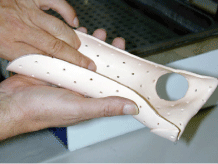
Splinting made simple
|
Memory
All Multicast products have 100% plastic
memory. That means the material will recover
its original size, form and thickness
after reheating. Splints can be remolded
as frequently as needed!
|
Transparency
Multicast Ortho and Multicast Standard
turn semi-transparent when heated. This
enables the therapist to see contours
and landmarks under the material. Multicast
Rigid and coloured materials become opaque
when heated.
|
Drape
or conformability
All Multicast materials are superior in
following the exact contours of the treated
surface, even to the minute details, due
to their exceptional anatomo-topographic
properties.
|
Stretch
Multicast Ortho has maximum stretch resistance
and will resist stretching with force
of gravity. Multicast Standard and Multicast
Ortho have moderate stretch resistance
which allows control over the material
and offers a variety of handling techniques.
Multicast Rigid is a material with a minimal
stretch resistance. This property is used
for the ease of circumferential splinting.
|
Ease
of finishing
Multicast generally has exceptional smoothing
capabilities when heated. The unique coatings
of Multicast Standard make fingerprints
and other surface marks disappear. Multicast
Ortho resists fingerprints too while the
material is warm.
Major modifications can be made with
heat gun. It can also be mechanically
grinded or buffed for quick finishing
(at a moderate speed). Modifications should
only be carried out when the materail
has completely cooled down.
|
Bonding
Uncoated materials such as Multicast Ortho
and Multicast Rigid have a moderate degree
of surface tackiness. It helps the material
cling to the patient’s skin to achieve
more precise contouring during moulding.
No solvents are needed to bound two pieces
of the material together. Strong bonding
can be achieved by applying dry heat.
Cutting: May be cut
when hot or cold with scissors or knife.
Bonding: Self adhesive
when hot - just by pressing the materials
together firmly.
Fastening: Hook &
loop, rivets, etc. No solvents needed!
|
Processing
temperature
Uncoated materials like Multicast Ortho
and Multicast Rigid can be processed at
the temperature of 60°C – 65°C
(140°F - 149°F). Multicast Standard
have a forming (processing) temperature
of 70 °C - 75°C (158°F - 167°F).
All Multicast materials are designed to
be moulded directly on the patient’s skin.
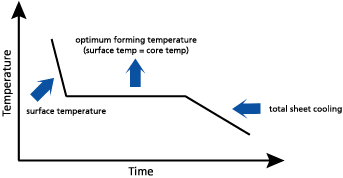
While processed in hot water the material
absorbs heat, but when taken out of the
water surface temperature decreases automatically
till 30°C. See below:
|
| |